Sunday, 5 June 2016

The man who saved St Basil's - a graphic story about Pyotr Baranovsky / Комикс о Барановском.

I have been interested in Pyotr Baranovsky (1892-1984) for several years, studying his life, and the buildings he restored and saved from destruction. At the end is a map showing all the buildings he worked on in Moscow. This story that I did in 2013 focuses on St Basil's and Kazan Cathedral on Red Square. 


© Clementine Cecil All rights reserved 


Map of Moscow showing architectural monuments Baranovsky worked on during his lifetime - below is a key


1. Surveyed architectural monuments 
2. Architectural monuments for which restoration projects were devised
3. Restored architectural monuments
4. Architectural monuments saved from demolition
5. Architectural monuments that were demolished
6. Architectural monuments that were reconstructed with consultation from, or using materials from, Baranovsky.

Sunday, 29 May 2016

Wiveton Hall Walled Garden

Wiveton Hall walled garden is without doubt one of my favourite places. It is somewhere I bring beloved visitors from Russia. It's been open to the public since the cafe opened 9 years ago, and now with the runaway success of Normal for Norfolk, will be visited as never before. I went there on this misty bank holiday weekend, and it still feels magical and remote. 


Desmond and Chloe in the cafe


The gate to the secret garden

Until I was 17 we rented Dairy Cottage where Desmond’s Aunt Chloe now lives, for our summer holidays. Can there be a better place for children to run wild? 

The walled garden was somewhere we particularly liked to explore. We ate mulberries from the tree and played cards in the apple house in the middle of the night. Desmond had just branched out into soft fruit and the garden was still Aunt Chloe’s territory. Aunt Chloe, now famous thanks to Normal for Norfolk, has fingers as green as they can be. The garden was wilder then, as only she was gardening it, and utterly beautiful. 

It is still beautiful, but more professional - with flowers laid out in rows for the tables in the cafe, and vegetables. There is now a peony walk which is worth arranging one’s visit around (they will flower in June), and a herb area.

The walled garden has a puzzling shape - a triangle or wonky rhomboid - however if you look at the ground plan of Wiveton Hall from above it forms a corner. See below the great painting of the Hall and its grounds by Desmond's sister Mary. The north facing wall is high at its west end - this is because after the 1953 great flood, when it was flattened, it was rebuilt at a lower height.

Desmond pointed out to me that the wall had been rebuilt using concrete rather than lime mortar, and that whoever built it was paid for the job rather than by the hour as it all went up at once rather than in courses as the other walls are. The work is less fine but interesting to look at in contrast to the other walls.

Behind the great walls are flat saltwater marshes that stretch a mile to the North Sea. These walls create a microclimate that protect everything within from the harsh northern winds. This manmade miracle has created a secret world that Desmond, his mother and now his team, have preserved and enhanced over the years. As Desmond said in Normal for Norfolk 'some people grow christmas trees in their walled gardens; I wanted to try and keep it as a garden.' Although labour intensive, the garden provides for Desmond's table, the cafe, and the shop. 

Desmond’s father was playful - when he rebuilt parts of the wall, Desmond points out to me, he would insert some older masonry into the walls to strengthen it. Flint and lime walls are not strong enough alone - some strengthening is necessary - either bricks or pieces of masonry. This, his father would say gleefully, will confuse future architectural historians! Norfolk is full of churches and former monasteries and finding pieces of masonry on the wayside was common when Desmond was a child. 


reclaimed medieval stone masonry used by Desmond's father to reinforce newly repaired wall of the kitchen garden
In Edwardian times the brick path was built from the gateway creating a walkway through the garden. At this time the Hall had been bought by some wealthy Edwardian shipping merchants - and the 17th century Hall was extended, beautifully and subtly in the same style, in 1908. This brought it closer to the kitchen garden and at the time it was fashionable to make the kitchen garden a feature of the grounds, thus the brick walkway was constructed - for the perambulations of edwardian ladies in long skirts. They would walk between flowerbeds full of roses, sweet peas and lavender, lined by espaliered pear trees and sit at a bench beneath the high buttress. It is still a wonderful place to sit.

The Edwardian era brick path leading to the bench underneath the original high wall, behind which is the marsh and then the North Sea

Dairy Cottage, where we used to spend summers. 
beginning of Peony season, 2016


Looking up the path towards the gate 


The pond and apple house, with a wooden shingle roof

Corner of the garden, with stepped flint wall
The coursing in the flint wall on the left is clearly evident: bricks and flint


Wiveton Hall (1652, extended 1908) painted by Desmond's sister, Mary MacCarthy. Here you can see the shape of the kitchen garden and how it fits in with the form of the estate 

Monday, 23 May 2016

The Punk Angels of Shoreditch Church

Roll up, roll up, for the final couple of weeks of Development Hell - showing at St Leonard's, Shoreditch. If the name makes you feel gloomy, let me assure you, a visit to this church raises the spirits and the exhibition is full of humour as well as dark realities.


Development Hell was conceived and curated by Robin Hatton Gore who organises events at the church, to be "An exhibition of contested spaces in Shoreditch seen through art and documentation.” It is about local planning battles, which happen to be some of the fiercest in the country: Bishopsgate Goodsyard, Norton Folgate, and others. These fights have given rise to a great pulling together and creativity, and this exhibition exemplifies that. Development Hell acknowledges the importance of these fights - recognises their injustice - and celebrates the creativity of the campaigners, as well as giving campaigning tips.  The bravery and willingness of this church to be outspoken make it something of a crusader.


The elegant Grade 1 listed building was completed in 1740 by architect George Dance - though there has been a church on this busy Shoreditch junction for hundreds of years. Unlike the proposed new towers that the exhibition opposes, the church is positively engaged in the local community. It has a drop in centre for those suffering from addiction, 12 step meetings are held there, as are fundraising concerts for charities, and cultural events. 


The church’s vicar Paul Turp, a man of refreshing honesty, in and out of the pulpit, together with Robin, recognised that the community is not being given a voice in the gargantuan and invasive plans for the Goodsyard and Norton Folgate. They held a first exhibition last year drawing attention to these planning applications with a view to providing the community with a platform and empowering people to object. They have held several fundraisers in the church for the same purpose. 
Painting by Gram Hilleard 

This second exhibition is more ambitious and very much worth a look. Robin, an artist by training, has mounted the show beautifully in the light-filled gallery, rebuilt in the 1990s after it was stripped out by zealous Victorians in the 1870s. A fine organ, dating to 1756  presides over the exhibition.  


Other organisations taking part are: SAVE Britain’s Heritage, the Spitalfields Trust - so fiercely battling for the right solution in Norton Folgate, and the terrifyingly named GAG - Goodsyard Action Group, fighting the Bishopsgate Goodsyard plans for a wall towering skyscrapers, together with action group More Light More Power. 

As a counterbalance to the threatening darkness, Robin invited artist Andrea Mclean who lent a picture depicting William Blake’s vision for a City of the Imagination, Golgonooza.  Other artists taking part are Gram Hilleard, Adam Dant, Jamie Reid and The Artist of the Ant, Paul Sakoilsky, Neil Cummings, Lucinda Rogers and photographer Max Reeves. 

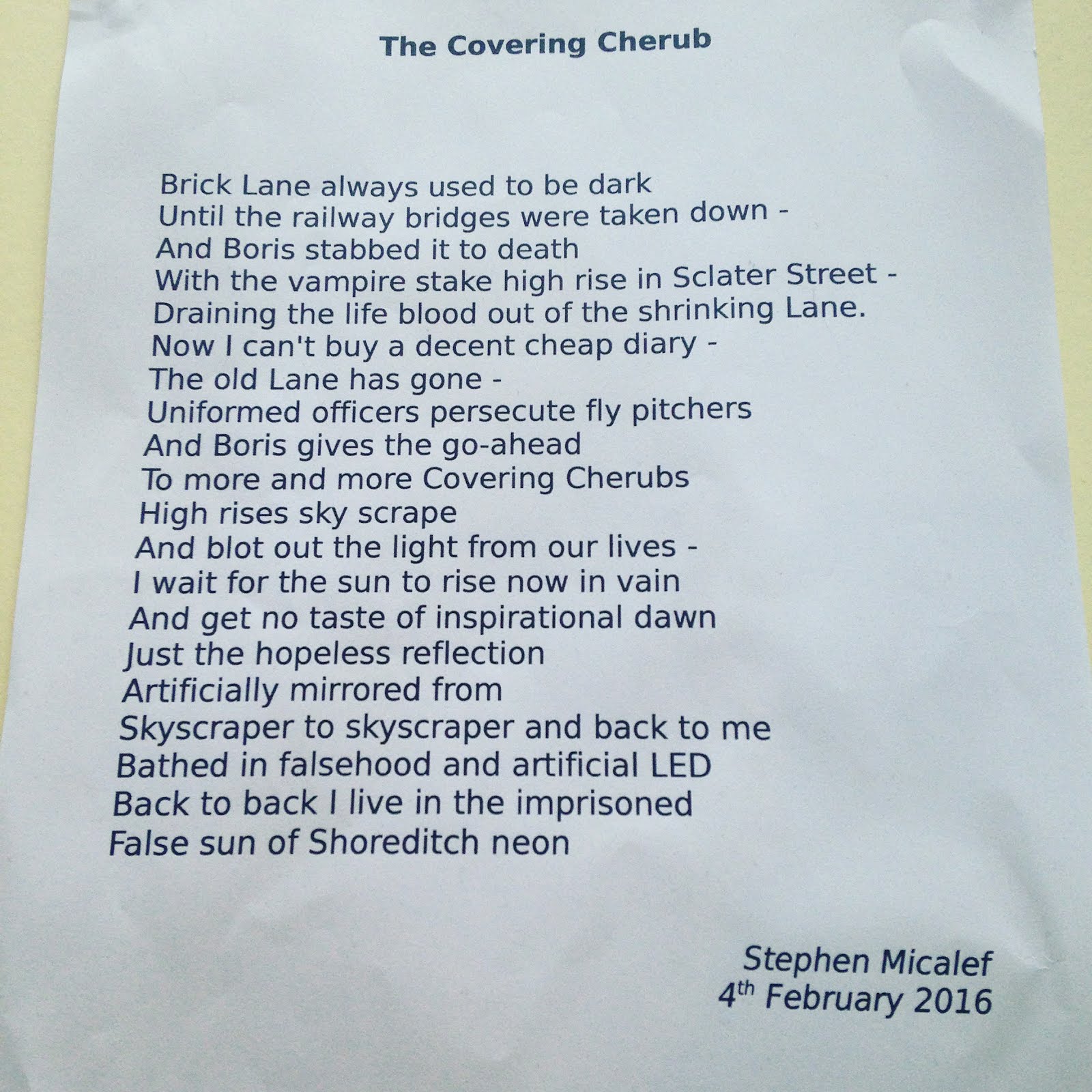
Poet Stephan Micalef wrote some poems for the exhibition which are included. Earlier in May, Robin also organised a protest poetry evening of poets reading their work about the developments, with a Blakean theme, called Dark Satanic Millionaires.


Practical advice and inspiration for the campaigner are also here: SAVE’s vision for the Strand buildings that were almost demolished last summer, drawn by architect John Burrell, and their flowchart (created by myself and Mike Fox especially for the exhibition, and designed by Olga Gusarova Tchalenko.)


Robin has made some stunning posters for the exhibition that I include here: their punk aesthetic and thoughtful content are activism of a powerful kind. They have a Blakean theme, calling the campaigners 'recording angels', and the artists 'interpreting angels.’ I remember one of my predecessors at SAVE citing ‘wanting to be on the side of the angels’ as being a major motivation for developers to stop fighting the local community and to work with them. Let’s hope that this exhibition creates a few angels. Go and have a look and take your local property developer. 

The exhibition is open until 5th June between 12 and 2pm every day, or by appointment.  To make an appointment outside these hours contact Robin Hatton Gore: rt_hattongore@yahoo.co.uk 


Monday, 16 May 2016

Moscow New Year 1993: Russian and other languages.


One day, Lex announced, into his moustache and with little enthusiasm, that Ira Vashchenko had bought tickets for the theatre. I still didn’t really know Ira and felt shy of her -  apart from in Liza’s home in Chiswick, I had only spoken to her a little, on New Year’s eve. Maybe because she knew Liza and I felt that I ought to have been able to speak Russian better than I did, or because I was agonisingly self conscious. I wore all grey clothes and army boots as I hadn’t known what to wear for a New Year’s trip to Moscow - that way I was camouflaged and vaguely sexless. Indeed, on getting off the metro at Arbatskaya a man took me under the arm one day and said ‘girls shouldn’t dress like this.’ It was an admonition. Ira, an artist, at that time painted the blind facades of buildings facing into courtyards with narrow strips of sky above them. She wore long skirts and pretty beads, and her hair was cut in a loose bob below her ears. She was smiling and joyful and even though she had strong opinions about things, she laughed easily.

The tickets were for Leshchi - The Wood Demon - by Gogol. I remember the papery tickets and the theatre foyer - the dim light emitted by the wall-mounted lighting, and the parquet floor, with its large pieces of wood, pale, varnished and well trodden. I don’t remember anything about the spektakl itself - I would have been happily sunk in my own thoughts, the alien words flying over my head. I remember coming out on to the street afterwards, all of us wrapped up in our winter clothes. Ira had on a long coat - she caught me by the arms, laughing, and span me around on the snowy street. I was startled and happy that she had done this, had shown me this much attention, but too shy to respond with anything but a smile, my body refusing to carry on the moment and swing itself around. I dropped my arms awkwardly. 

I was in the magical early period in my relationship with Russia when I felt I had nothing to offer, and was painfully aware of not being able to speak the language. I felt Ira had bigger fish to fry - other conversations to have. So her swinging me around in the snow was a great honour, that I didn’t know how to rise to. It was her way of talking to me. Most people have another language apart from actual words: Lex and I had the language of vodka - Yuri and I had his broken english - Sveta and Lex’s mother embraced me in their maternal kindness and the language of giving (lots of food) and Ira’s bother Senka and I spent an evening walking around Taganskaya in total silence eating ice-cream, him in a battered WW2 flying jacket. Needless to say, Ira and I now sit for hours chatting and drinking tea in the window of her Moscow apartment, the tree branches close up against the window. 

Monday, 9 May 2016

'My Stubborn Tongue'

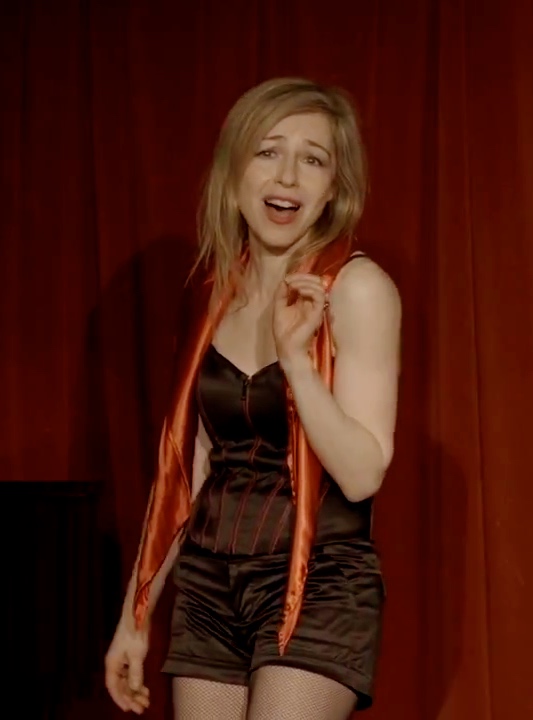
This week Anna Fishbeyn came to Pushkin House with a performance that rocked the rafters of our 1703 abode: My Stubborn Tongue. Through acting and singing, with a piano accompaniment, Anna recounts the experience of moving to the U.S. as a 9 year-old child as part of the Jackson-Vanick agreement between the U.S. and Russia, when Russian Jews were, effectively, traded for grain. As she says: “America wanted the Russian Jews to demonstrate to the world how oppressive the Soviet Union was, and Russia needed grain, Russia was starving.” Against this bleak backdrop of human trading, Anna with great humour and insight recounts the ups and downs of being a Russian immigrant with an accent in the US at a time when people with accents were treated as second class citizens (as is still the case in some places). Anna watched her mother continue to be mistreated in department stores and restaurants simply because of her accent, and her family was repeatedly told to go back to Russia during their early years in the U.S.
 
The stunning Anna Fishbeyn in action
Anna decided to train her accent out of her tongue and to become as American as possible. She changed her name to Annie and spoke flawless English. But her roots were betrayed when her friends would come to her house to be fed Salat Olivye and encouraged to participate in the family’s regular after-dinner performances as her father played the balalaika and her mother sang opera. Her mother and grandmother had drummed into her head that kissing led to sex and sex could lead to only one thing - marriage. So when Anna started to date, she didn’t simply open up about her origins - she “forced her culture” on her dates: she would turn the subject to Anti-Semitism and Stalin before the bra could be removed, and perhaps sing some Russian laments. This was in order to check whether the boy in question was willing to take this stuff on.

As an immigrant, Anna needed to convey to the person she may be about to become intimate with, something of herself, what she had escaped, her background - that even if her family chose to leave that culture, part of it stayed with them. She does an impression of the guy’s response upon hearing about her Russian childhood, ‘Um I can understand that’ he says, desperately trying and desperately keen to get her bra off, ‘Actually I can’t understand that because I grew up in California, and it was pretty sunny, you know like the S.U.N,” pointing at the sky, “and Vitamin D gives you endorphins.” Touchingly, at Thanksgiving, the toasts are all to America; and the family attempts to feed Anna’s American friend the delicacy of cow’s brains as well as the turkey. 

I identified with this behaviour with boys - even though I never emigrated to Russia, I immersed myself in Russia over the years when most of my friends were rooting their lives and careers in the UK. It was hard for me to reconcile these parts of myself when visiting home from Russia, or even for the first years after my return when I was still traveling there a lot. On dates with ‘suitable’ English boys, I would rabbit on about Russia and use Russian words when nervous - I wanted to see if they would take it on, but also, for me, it was a safety mechanism to hide behind. And anyway, deep, dark intense subjects are a good precursor to sex, aren’t they?

Anna Fishbeyn performing in 'My Stubborn Tongue'
Having passed entirely convincingly as an American for many years, Anna decided to embrace her Russianness. She reverted to Anna (the Russian pronounced more like Honor) and began having to explain herself at parties. She was stunned by how little people knew about Russia. She said she originally wrote the play for her grandmother who came to the U.S., and never learned English. “My grandmother used to say, ‘We suffered in Russia and we suffered in America, what is the point of life?’” says Anna, “I wrote the play as an ode to my grandmother, an attempt to make sense of her suffering, of immigrant suffering.” But Anna also concedes that she wrote it for herself, to reconcile the disparate parts of personality. She does this literally also - this is a one-woman show and she plays several parts: her mother, grandmother, aunt, father, several non-plussed American boys, an Estee-Lauder saleslady, her ex-fiancé and his mother, and herself.

Her director is an American-Romanian, Adrian Roman, who saw his own story in Anna’s when he first saw the performance. In this sense, hers is a story anyone who has emigrated or lived abroad and embedded themselves deep into another culture, can identify with. Many people who come through the doors of Pushkin House - whether it is Russians now living in London, or other foreign nationals who have lived a long time in Russia - have a misplaced or split identity syndrome, confused cultural references and a desire to piece it all together. Anna Fishbeyn performs this reconciliation in her play: watching her perform was healing and exhilarating.


Tuesday, 3 May 2016

The shuttle and the egg: a Russian Easter blog.


The apartments on Golden Lane where I live have little storage and the aesthetic is minimalist. Even so there are many things that decorate my rooms that serve no purpose but I am unable to throw away. In this and coming blogs I write about some of my Russian objects.

This shuttle was given to me by my Yuri and Sveta Vashchenko who have looked after me so well in Russia, especially in the first years I travelled there. Their dacha in Kostromskaya Oblast is full of such things - inherited and found in the empty dachas in the village and neighbouring villages, some of which are entirely abandoned. 

From first visiting Russia I always found that there was little to collect - few beautiful things were available to buy - this is no longer the case but it was then - it was difficult to decorate my flat and make things pretty. But Sveta always could. She could make a dish of lobio from tinned kidney beans taste wonderful and fresh, just with the help of a sprig of coriander. She could make soup out of some herbs from the dacha garden and some tinned meat. She could make breakfast pancakes out of a cup of milk and some flour. And she could decorate with whatever was to hand: their dacha is decorated with these peasant objects - utensils, tools - and also embroidered linens. In the 1980s, my mother invented the phrase ‘shabby chic’ - Sveta was also a natural adept. Their apartment in Moscow was made decorative and sophisticated by the lightest of touches. In their case it was elegant, simple, pre-revolutionary art nouveau photo frames, often with tiny openings for the actual photo. Yuri and Sveta’s bed has, instead of a bedstead - a dozen or so of these on the walls, holding tiny photographs of their parents and themselves and their children, some of them processed by Yuri in the darkroom in Sveta’s former studio. 


Their bed was narrow - I only noticed because we arranged for an American photographer to stay there one summer when they were at the dacha and he mentioned it - that it was the size of a single american bed. In the countryside Yuri and Sveta often slept in the senoval - the hayloft - where tall grass from around the house, scythed (by Sveta) was dried and then placed. It was the most fragrant place to sleep in the world. It was also incredibly romantic and couples who slept there would skip down to breakfast in the morning with a spring in their step and sing song voices. Indeed I had my first sexual experiences in Russia on the senoval at the dacha. I smile to think of it now - I was 19 and the boy in question a little younger. And there was another boy who slept there too - we always thought he was asleep - but I heard him whispering about what he had seen to a friend of his later on in Moscow, and was mortified.

I marvelled at the aesthetics of Yuri and Sveta. They knew and recognised the natural, the authentic and knew to cherish it, in a blighted country where there was so little that was decorative. I wanted to recreate it, but I couldn’t, not in Russia - I didn’t know how to handle, nor find, the materials. Yuri and Sveta did - they had an eye for it. This present of the spindle was part of that. It is made of birch wood and is very light. It was made by hand, and has been smoothed and polished by use and extensive handling. It was a kind of blessing for my choosing to be in Russia.

The egg I bought in Izmailovo - the flea market where you could, beginning in the late 1990s, buy soviet objets. Handicrafts began to become more popular to at this time also and painted eggs were one of the things that were sold. 

This weekend was Russian Orthodox Easter. At home people colour eggs dark red with onion skins - or you can buy turned and painted wooden eggs like this - a symbol of rebirth and hope.

Monday, 25 April 2016

New Year 1992-3, Stary Arbat, Moscow

(a continuation from earlier blog posts)

Leaving Lex’s parents apartment, we walked a little way up the deserted Arbat, recently pedestrianised, and then ducked under an arch that ran under a building and led into a courtyard. It was snowy and the street lamps threw a dusty yellow glow on to the snow. I followed Lex to a corner in the asymmetrical courtyard and we were buzzed in. The juddering lift lurched to a halt at the fourth floor and at our ring the door opened on to a flat chattering with voices, full of smoke, and the twirl of dull-coloured skirts and a smell of sweat that didn’t smell English. The door opened straight on to a corridor that ran down the centre of the flat, with the rooms opening off it. The walls of the corridor were lined books, and it felt like a party flat - there was one big room and the other rooms were small - Nikolai Vsevoldovich’s study, the kitchen, and the youngest son, Tikhon’s bedroom. These were the Kotrelevs - a Moscow intelligentsia family. Nikolai Vsevoldovich was an esteemed translator of the Russian nationalist philosopher Vladimir Solovyev. His wife was a petite swarthy woman called Tatyana and nicknamed Chuda - miracle - her expression was provocative and wry - this was clearly a family that had been brought up on teasing. She taught art zaochno - by correspondence - the apartment was full of painted boards and canvases sent to her from all over the former USSR, of the interior of peasant huts, still lives, flowers, a cross between outsider art and Russian academia. There were four children, which seemed a normal amount to me, being from a family of four, but it was clearly not the norm, somehow this family was different, upholding something traditional in a society where the family unit had been put under serious strain. There were two girls and two boys.

By the time we had arrive at about half past midnight, on the first day of 1993, the zastol’e had broken up and people were moving hither and thither in the flat. Chuda ushered us into the kitchen, which was full of smokers, and offered us a pirog baked in a rectangular tray with thin flat pastry and a fine layer of cheese. To her amazement, I turned down the great delicacy of the jellied beef. Chuda was dashing around twittering like a bird and Lex was laughing into his moustache. She sat us down at the tiny kitchen table and with a great sigh pressed play on the clunky buttons of the answer machine. The tape whirred and a deep bass voice, with very correct pronunciation said ‘Mamochka my dear, Happy New Year. We have marked it here in Askhabad. I am still in prison but they are letting me out in a week. They have cut my sentence. It is not bad in the prison, we made a pirog. What else… Next week we will resume band practice and the band says it is missing me I think that is why they are letting me out. My tuba playing is coming on very well. Kiss everyone from me and I kiss you. Poka’ This was, Chuda’s eldest son, the apple of her eye, and Lex’s great friend. He had a fine voice. He was on army service and had been posted in Turkmenistan near Ashkhabad. He had been put in army gaol for carrying a pistol when he went into Ashkhabad in mufti. Chuda relished the story of her good little boy being so bad. Lex translated the story into Lex language which I had mastered by this time.

Moments later I was cornered by an enormous young man, Vanya Simyonov, who was all beard and booming voice. He asked me how to translate the Old Russian liturgy into old english. I looked at him in puzzlement, feeling like a terrible ambassador for England and a disappointing visitor. I couldn’t tell him anything at all about old english except say ‘Chaucer’ with a Russian accent. I felt stupid about that for twenty years until he and his family came to stay and I introduced him to a Russian priest in a village in norfolk with whom we had tea - an exculpation. 

By this time, Lex was making murmured goodbyes and bundling me into my coat. New Year’s night is short and there were many friends to see - onwards!

Two blocks up the Arbat we turned into Starokonyeshenny Pereulok and then right under an arch into another courtyard. Past two rubbish containers we arrived at a door. Lex pushed against the door - it opened into total darkness. We walked up seven flights, each flight curving steeply back on itself. At the top we came face to face with a cage. This was the first time I had come up against the Russian phenomenon of inhabiting spaces that were not intended for habitation - the fag ends of buildings - the storage areas. A shadowy figure appeared behind the cage and shoved his hand towards us filled with a bunch of jangling keys. In a sing song voice he talked Lex through unlocking the caged door. The door behind that, glowing with light, led straight into an enormous space - a studio masterskaya - the place where the master works. 

Yuri Vashchenko was the father of Lex’s great friend Ira - he was an artist who lived part of the year in America - and this was his masterskaya. With exaggerated chivalry, Yuri divested me of my coat and hat and hung them up. It was the attic: the space was divided into two - one half was a large room with a ceiling that sloped from the centre towards a window that looked over zinc roofs. Large canvases leant against the wall that divided the room from the other half of the attic, where, I later saw when I peeked in, was a large brass bed and a small skylight under which was placed a chair - oh toska! And then, tucked away in an awkward corner, was the most important spot of all - a makeshift kitchen made up of a miniature fridge, single hotplate and a couple of shelves, and the table - round and low - the walls hung with carpets and an oval mirror - a long low velvet upholstered day bed, and the steps up into the main room made extra seats. By all accounts this was the least prepossessing part of the room - no window and a low ceiling - but what need for windows when you have each other to look at, and a low hung light over the table! The window, letting in the prosaic thing known as light, had a practical purpose, to help Yuri create work.


Yuri’s wife Sveta was sitting by the single hot plate, and turned to us with a smile, rising and with her arms outstretched pressed Lex’s shoulders and kissed him on the forehead. She gave me three vehement kisses hello. She was playful and radiant. It felt like a mixture of the beginning of a great adventure, and of coming home. They had not yet eaten. 

Monday, 18 April 2016

Ian Constantinides, conservation builder: Up from the Ashes

To Somerset for the second memorial lecture in honour of Ian Constantinides (1955-2013) a conservation builder of great  character, who I was lucky enough to know during the last five years of his life. He won me in an auction: he chose to ignore the prize (a journalistic masterclass) and instead invited me to one of his lectures, that he was giving at the SPAB, on restoring plasterwork. I was immediately entranced by his manner of delivery and voice (watch a short clip here from 1.10 minutes in). At this lecture he said that the only way to appreciate a stucco ceiling was to lie on one’s back and look up - something I have since taken to doing. 

Ian Constantinides on the job
Ian drove me to dinner at Blacks in his open top car and we talked about Moscow, where I was working at that time. A couple of years later he accompanied me on a research trip to look at Golden Ring Churches. By the end of a week with Ian my eye was eagle sharp - he was an expert at looking, and at asking questions. He could see which repairs were old, which fresher, what was natural wear and tear and what was manmade. When he looked at a building he was trying to understand the decisions behind the design, and the repairs. The thing that enraged him - and he liked to get enraged - was fuzzy thinking. While enormously appreciating old buildings - their smells and textures, craftsmanship of all levels - Ian was not sentimental. When I posited that I was thinking of removing the wood veneer floor from my Golden Lane flat and replacing the original parquet, he said ‘why? this floor is working perfectly well and it is extremely practical.’ He realised that I probably wouldn’t gain pleasure equal to the amount of effort and money it would have costed. He was right. 
Ian Constantinides in story telling mode, in the chapel he lived in, extravagantly decorated with ladies' dresses and mounted animal heads.
The lecture this year, organised by Ian’s widow Sarah Constantinides, was called Up from the Ashes: The Restoration of Historic Buildings After Calamitous Fire. Some of Ian’s major achievements involved rebuilding post fire: Uppark House, following the fire of 1989, Prior Park, burnt down in 1991, Windsor Castle after the fire of 1992, and St Ethelburga’s church in the City of London following the IRA bomb of 1993. Ian disliked the cult of expertise - he always called himself a builder and considered that the best way to learn was on the job. Under his supervision, master craftsmen were born at the sites he restored - they learned from copying the work of masters that they were reconstructing and restoring. Working parallel with Ian at Uppark, was Geoffrey Preston, who restored the plasterwork. He is now one of the most skilled architectural sculptors and creators of fine plasterwork in the country. His work is breathtaking. 
Uppark after the fire, in the foreground, bins containing ashes and fragments.

Restored and reconstructed plaster work at Uppark, by Geoffrey Preston
Another master, Clare Venables, also spoke. She restored the plasterwork at Windsor Castle after the fire. The plasterwork is a riot of gilded baroque scrolls, foliage and birds. Close up it less refined than that at Uppark, but as Clare pointed out, it was to be seen from much further away as the ceilings are 40 feet high. 

The skill involved in this level of craftsmanship is truly staggering. When Uppark was burnt out, there were not the existing skills in the country to restore it - neither for the plasterwork - Geoffrey Preston was still training - nor for the woodwork. The carpenter’s guild closed ranks on Ian as they knew they could charge whatever they wanted for the work - it was the biggest job going at the time. Ian refused to deal with them and opened the tendering process up to non professional carvers, asking them to send in samples. In the end the team was made up of both: those with little or no training indeed did learn on the job. 

Salvage squad in action at Uppark
The talk on friday opened with an enlightening introduction from Martin Drury. Drury was chairman of the National Trust during the time of several fires. He talked us through several of these, and the lessons that were learned. Following the fire at Nostell Priory in 1980, the National Trust realised that there were not enough photographic records of their properties. As a result, they invested an enormous amount in recording their buildings after this, thanks to which there was a thorough record of Uppark when it burnt in 1989. Martin Drury showed extraordinary photographs of salvage squads, including the the Meade-Fetherstonehaugh family who lived in a part of the house, at work clearing the house of its contents as the fire raged. All in this short National Trust video. 

By the end of the evening, after a raging debate over the value of rebuilding that which is lost, we understood that great craftsmen are trained during these reconstructions. It was also clear that the sooner the decision is made the better, while the memory of the house is still alive. A decision has finally been made about Clandon Park and what is to be done there, following last year’s fire. Martin read us the National Trust press release and the news that it is to be restored to a better version of itself, rather than as it was just before the fire. Here is an extract:

Dame Helen Ghosh, the Trust’s director general, said:

Fire at Clandon Park, October 2015
“The fire at Clandon was shocking, but gives us the opportunity not only to show our respect for the heritage of the past, but also to create new heritage for the future. Our plans involve returning parts of the house to its 18th century glory whilst at the same time creating a building of beauty and relevance for the 21st century. Given their historic and cultural significance, and the fact so many original features have survived, we believe we should restore the magnificent state rooms on the ground floor – the most architecturally important and beautiful rooms.The loss of so many of the contents of the house means that we cannot return it to how it looked the day before the fire. However, we now know more about the original layout and recognise that the enduring significance of the house is its architecture and so we would like to return it to the 18th century design – making it a purer, more faithful version of Clandon as it was when it was first built.”

Restoring it to a better version of itself is extremely ambitious - for one thing, nobody has seen this version. And saying that it is an opportunity  “to create new heritage for the future,” gives me the creeps: that is exactly what the Mayor of Moscow did in the 2000s, leading to inaccurate results and setting disastrous precedents. However, hopefully no such excesses will be pursued and I wish them all the best: after all, rebuilding Uppark was also very ambitious and it was a success.

One lady in the audience had recently visited Uppark and said that information about the fire and subsequent reconstruction was not in evidence. When asked, one of the guides had said to her that there had been a reconstruction, all done by eastern european workers. There is no record of the fire on the website.

I hope that at Clandon, the work of the craftsmen restoring and reconstructing, and the innovative methods they will inevitably have to come up with, will be celebrated. And that a new generation of woodworkers, plasterers and masons subsequently grows out of the tragedy of the fire. 

Ian would agree, this would be the most valuable gift that could come out of this tragedy. On the same note, his widow Sarah is at present creating an education fund in Ian’s name to provide training for young restorers. For more information, please contact Sarah Constantinides sarah.buscottfarm@gmail.com. 
Ian in 2012

Spotted in Ian's loo at the chapel


Sunday, 10 April 2016

David Sarkisyan: sparkling magician in the Moscow murk

Dear Reader, it is with delight that I return to this blog after a transitional month, leaving SAVE Britain's Heritage where I have worked for the past 4 years, and then a break in Sri Lanka that has left me renewed. Tomorrow I start work at Pushkin House.

Today I sent to Moscow an updated version of a piece about former Director of the State Moscow Shchusev Architectural Museum, David Sarkisyan, who was a great friend and ally in campaigning to save buildings in Moscow.

I post it here below: it will be part of an anthology of essays about him by his former friends and colleagues, to be published later this year, along with a full list of the exhibitions he curated at the museum, and a detailed biography.

This is a personal take on David: he was an extraordinary person - I still miss him a lot, seven years after his death. He was able to be friends with even the most difficult people, such as the late Zaha Hadid. I once attended a lecture she gave, with him, in Moscow. I left after 20 minutes as I couldn't bear to see her being so rude to the interpreter. Years later, she attended the opening of Richard Pare's exhibition of photographs of Avant Garde buildings at the Royal Academy. She gave a speech and dedicated it to David, in a moment that, for me, revealed her humanity.

When David was appointed Director of the Architecture Museum on January 1st 2000, Moscow's architectural world went into shock: who was this upstart Armenian, he wasn't an architectural historian or an architect, he was a pharmacist and friend of Jeanne Moreau! Within months these fears were allayed by David's natural charm and charisma. He threw himself into the job with great energy, curating and hosting dozens of exhibitions. He transformed the Museum from a shabby Soviet backwater, a stone's throw from the Kremlin, into a hip, happening place.

I also briefly outline how David carried on the work of great crusading Russian conservation campaigners, during his time at the Museum.

---------

David Sarkisyan in his extraordinary study
When I first met David in 2002, I was tired of Moscow and my job, writing gloomy news about Russia for The Times. I remember stepping into his office to interview him for an article, and feeling that I had stepped out of ‘black and white’ Moscow - the dismal streets, the painful thaw of april, into a technicolour film. We talked about the architects Chechulin and Vlasov, whose great imposing drawings were on show in the museum; and then David told me a story involving Brezhnev’s daughter and a sword, explained the genealogy of the French Consul and showed me some photographs of his new friend Zaha Hadid. We drank tea and smoked and laughed. When I walked out, several hours later, on air, my love for the city was reinvigorated. 

Over the following year, I witnessed the rapid transformation of the Moscow I had known and loved for many years: I wrote often about Moscow Mayor  Yuri Luzhkov’s gargantuan construction projects; the building where I lived, of which I was very fond, was actually demolished. To help battle the destruction that was being inflicted on the city’s buildings to make way for crass new development, two other city residents, Kevin O’Flynn, Guy Archer and myself, decided to create the Moscow Architecture Preservation Society - MAPS . I wrote to David about our plans and he reacted swiftly in an email saying BRAVO, CLEMENTINE! and inviting me to come and see him forthwith. 
Sculpture of former Mayor of Moscow, Yuri Luzhkov, playing tennis with great vigour, by Zurab Tseriteli, great friend of the Mayor. 

I spent the whole of the following week in his study, writing press releases and gathering supporters for the first press conference. It was David who ensured that it was properly attended by key players in the debate, from Alexei Komech, Natalia Dushkina, Andrei Batalov, Grigorii Revzin, Anvar Shamuzafarov and Boris Pasternak to the Iced Architects and Tatyana Tolstaya. 

MAPS pledged to provide foreign journalists with fresh news about Moscow’s conservation battles. While many Russians raised their eyebrows as to why foreigners wanted to help protect Moscow’s buildings, David completely understood the potential of our initiative. “Bringing the discussion into an international arena is our only hope,” he said at the press conference, and with his showman’s flair, he would say, “our architecture is so beautiful that even foreigners are turning out to defend it.”
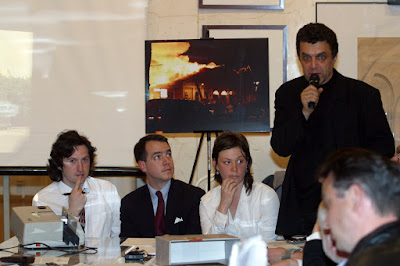

Kevin O’Flynn, Guy Archer, Clementine Cecil, David Sarkisyan 
First MAPS press conference, MUAR 28th May 2004
The picture behind us is of the notorious fire at the Manezh, 14th March 2004

David was one of the key providers of information for MAPS and the press - he realised the crucial role of the media in this unequal campaign, and without fail made himself available for interviews. The State Schusev Architecture Museum (MUAR) of which he was Director, became a centre for the  campaign to save Moscow’s endangered architecture. Organisations such as Moskva, Kotoroy Net (Moscow that is no more), Group 44 and 9, and Arkhnadzor, all used the museum for meetings and events.


Our friendship and work together was as a bridge that carried me deep into Russian culture; in turn MAPS became a conduit of information for foreigners and international journalists writing on this issue. Our work led to literally hundreds of publications all over the world and in many different languages.

Cartoon in the Moscow times showing campaigners pushing Mayor Yuri Luzhkov's wrecking ball ahead away from historic buildings. Published in The Moscow Times following the publication of the first MAPS report in 2007

In the following ten years, MAPS published four bilingual reports together with SAVE Europe’s Heritage: Moscow Heritage at Crisis Point/Московское Архитекурное Наследие: Точка Невозврата (2007), Moscow Heritage at Crisis Point, Updated, Expanded Edition /Московское Архитекурное Наследие: Точка Невозврата выпуск 2 (2009), Samara, Endangered City on the Volga/ Самара: Наследие Под Угрозой (2009), and St Petersburg: Heritage at Risk / Санкт Петербург: Наследие Под Угрозой (2012).

Moral support was the most valuable thing that David gave me and MAPS. In Moscow, where the fight to save built heritage is so tipped against conservation, it is impossible to work without that kind of support. David’s integrity, good humour and unswerving inner moral compass made him the natural bedrock for the campaign. If there was a problem, he was my first port of call; he invariably had a constructive idea for how to move forward.

As I got increasingly involved in conservation - studying the history of those who had fought to save buildings throughout the Soviet period and before, it became clear that David was working in a long tradition of heroes who made it their life’s work to save threatened buildings, to salvage fragments, to gather archival material, and create a repository that was not under danger of being destroyed by a state with a penchant for regularly rewriting history. This was an incredibly important and responsible role nationally, but especially in Moscow - the showcase city of the Soviet period, large areas of which were demolished and rebuilt many times.

The first Director of the Museum on Vozdvizhenka was leading Soviet architect Alexei Shchusev, appointed in 1945. He was architect of Lenin's Mausoleum, many important public buildings and metro stations, and had been active since before the revolution. Under his Directorship, the Museum became a centre for the fight to save buildings from the implacable Soviet bulldozers. The Museum also sent expeditions out to Novgorod, Pskov, Povolzh’e and other towns in order to survey and restore important architectural monuments.

Shchusev left his own archive to the museum and encouraged his colleagues to do the same. The result is that the museum is home to the archives of some of the country’s most important architects. It also contains important fragments of demolished buildings - many of which can be seen in the courtyard. David continued this tradition, taking in as many fragments of the Moskva Hotel following its demolition in 2004 as he could fit in the museum, which has extremely limited storage. In a terrible irony, this hotel was designed by Shchusev himself, completed in 1938. 

Pyotr Baranovsky
The Museum also contains the archive of Pyotr Baranovksy (1892-1984) - the leading conservation campaigner and restoration architect of Soviet times. His archive has its own room and archivists, still working on his papers. In the tradition David continued, Baranovsky was a tireless campaigner for the built heritage of Russia. He transported wooden structures from the north of Russia to Kolomenskoye in the 1920s, including Peter the Great’s log cabin from Arkhangelsk. This was the first open air architectural museum in the country. He also dozens tens of buildings in Moscow and throughout Russia over the entire Soviet period. It was he who recorded Kazan Cathedral on Red Square as it was being demolished in 1936, on the basis of which it was rebuilt in the early 1990s.

The buildings MAPS and David initially set out to save were of the Soviet era, many of which built on cleared sites of buildings that Baranovsky and perhaps Shchusev would have fought to have protected. However, the same principle applies - as Baranovsky said: “Without memory there is no consciousness. The restoration of a monument is the healing of consciousness”. David shared this belief and this mission; the saving of a building is the first step towards this appreciation, healing and integration.

I loved to see David out of his study - this was rare. I particularly enjoyed his visits to London, when he was resting and the stresses of Moscow fell away. He would stay in his beloved nephew Ashot’s apartment in Islington and we would idle away hours over delicious cakes in London cafes. I would arrange for him to meet my favourite people - one evening we ate pheasant fresh from Norfolk with the septuagenarian Irish travel writer Dervla Murphy, who had just bicycled through Siberia, and a host of cousins. 

David had the rare ability to combine frivolousness with seriousness - he made campaigning for Moscow’s buildings fun: his collecting of famous friends and objects, the endless stories, the delight in beauty. All this is encapsulated in the little glittering brooches he gave me - the starfish. I was not the only recipient - there are several of us lucky ladies with fine collections of starfish that we wear on our lapels. I would joke that it was the Order of David, awarded for perseverance in the face of difficult odds. They are also a symbol of his ability to appreciate the small beautiful moments in life that make it worth living. He never seemed to let one pass by. 

As I write this I am going to take up the post of Director at Pushkin House, London, a position he encouraged me to apply for just before he died. As always, I hope to carry some of his spirit with me as I continue my work with Russian culture, that was, in many ways, opened up to me by this extraordinary man.