Monday, 27 June 2016

Voyage to Siberia continued (2). Arrival at the village. July 1997

At the airport we were met by the broad and rosy Rosa, a Yakutian and the sister of Kolya, the former mayor of the village, Nelemnoye, our final destination. We were taken from the airport to a house ‘to rest after the road’. This was literal. The generously sized Rosa was keen on resting - ideally taking the form of sleep - this was an important activity to be indulged in at any possibility. She was lazy, with a sly look in her eye, and had the entitled air of the sister of a former mayor of a Siberian village. 


After a liberal snack of tea and homemade doughy pastries, I was shown to an empty upstairs room and one of the beds lining the walls. These homes were large, spacious, communal - there was enough room after all - but it was a matter of balancing size with the importance of keeping the cold out. And there was a dank smell in the house despite the fact it was summer: in the winter the windows are closed and muffled against draughts at all times - in the summer only one or two will be open, and covered with gauze netting to keep out the clouds of mosquitoes. I had never seen anything like these bare rooms - I was used to ‘interiors’ that had been styled and decorated. My mother was a journalist and wrote about interiors for magazines. My parents’ bedroom had recently been redecorated in yellows for a photo shoot. My mother had coined the phrase ‘shabby chic’ but this didn’t fit into that reference framework. These were simply rooms, whose size were dictated by the size of the kitchen where the stove was, from which everything emanated. There were few walls - personal privacy was not part of life here - people ate together, washed together in the bathhouse, slept in one room, sometimes one bed.

What shaky sense of time had returned to me post jet lag, fell away once more for we had entered the land of eternal sun and the light barely shifted until late at night. I have no idea how long I ‘rested’ on that bed. For all I know I’m still lying on it, a purgatory. The entire materik, is a purgatory, teeming with its own characters, rules and narratives.

The house was next  to the infamous Kolyma River itself, home of the Gulag. After an indefinite amount of time had past, we descended with our bulky bulging knapsacks to a tiny tinny open motor boat, that was being tethered to the shore by a twitchy swarthy-faced little man with a crooked nose and shifty eyes. This was Kolya.

Rain was melting from the grey sky: Rosa produced a roll of laminated wallpaper that she tore off and handed to me to cover my knees, (X, as a man, was not given any). Our bulky knapsacks pooled in water at our feet. 

Rosa whispered into my ear as we set off up the river ‘Kolya’s in trouble in the village. He sold his car to two different people today and they both are furious.’ I look up in amazement at the wiry man at the rudder - he was ducking and swaying to see over our heads and around the next corner and gave the impression that he wasn’t too clever with the motor. Soon we were lurching against a shore and Kolya was clambering up in order to deposit a cannister behind a tree. Benzin. This and dvigateli (motors for the boats) were in severe shortage that summer. Benzin was rationed - you could not be found with more than a certain amount, so Kolya stashed it up and down the river, leaving marks on trees to indicate where it was hidden. This was my first introduction to the language of the taiga - runes hiding corrupted petrol for knackered old motors.

The landscape unfolded around us. Within minutes of setting off we were alone in wild, unpopulated territory. We met no other boat for the duration of the journey. The shores were steep and covered in scrub and birch forest - the river twisted and turned, tho the water was deep and calm, ruffled only by the rain. My thoughts were focused on what was ahead, my ears full of the sputtering of the motor, my eyes straining ahead, the water seeping through the scraps of wallpaper that were disintegrating over my knees.


 After some two hours we turned a corner and saw a few boats lying on a small sandy patch and a group of people huddled on the beach, holding up coats against the rain - a welcoming party. We beached. The rain was heavier now. Leaving the bags to the men, and shouting hellos in Yakutian to the gathered party, Rosa pulled me up the slope and ushered me into the first dwelling we came upon - a small wooden hut. It was dark inside. As my eyes grew accustomed I saw that the hut was full of women - about 5 of them, lying over two beds. A television was on. They looked up at me - I was soaking wet and shivering with cold.


 ‘Snimite vsyo’ - ‘Take it all off’ - said Rosa. It seemed impolite to refuse and within seconds I was naked before the ladies and being ushered towards a bucket behind a curtain. I crouched over it and peed, trying to divest myself of embarrassment as well as my clothes. My pee made a tinny sound - the first sound they heard out of me even before I said hello. Roza handed me a pair of shiny nylon tracksuit bottoms and a baggy t-shirt and scratchy sweater which I pulled over my still wet, still cold body. Enclosed in these dry clothes I was invited to sit at a small table for tea, bread and moose meat. 

Monday, 20 June 2016

Voyage to Siberia July 1997

We had been in Yakutsk for a week. A week in the unrelenting July heat of central Siberia, everything covered in a film of brown dust. I was with a Danish post grad student, X. We were en route to a tiny village on the Kolyma river to make a documentary film about the last members of the Yukagir tribe for his MA in documentary film making at Manchester university. We were due to fly to Zyryanka - the nearest town to the village where the Yukagir lived, further upriver. Flights left randomly and while we waited we were being put up in a tiny apartment on the outskirts of the Yakutsk by an acquaintance of X’s, a teacher. 

Three months earlier, I had decided to accompany X at my own expense, having heard some of his hair-raising stories about hunting with local trappers in the forests of Siberia. One of them had particularly shocked me. X had been hunting in midwinter, with some shady types - skiing and with guns on their backs. Shady means that they were not very respectful of the law, or of much at all - they shot endangered birds and day to day life was rough. After some days of only eating bread, meat and sala (salted fat), X had become constipated to the point that he was in serious pain. One of the trappers had approached him with some rubber tubing and set up an impromptu colonic using snow. Not long after this humiliating experience X had developed flu and had to be carried some of the way. That day the trappers had killed a bear. They had stopped at a cabin in the forest and X had collapsed on to one of the hard wooden bugs and fallen into a feverish sleep. He had been awoken at knife point and dragged out into the snow where the trappers had skinned the bear and splayed it on a spit to roast. ‘A skinned bear looks remarkably like a skinned human, it was terrifying seeing it over the fire,’ said X - ‘they told me to fuck the bear.’ He had pulled out a knife and refused. It was a great story, that I now doubt the veracity of for several reasons. At the time that and another story that involved him hiding out in a forest hut for 6 weeks under constant siege from rats and bears after the dubious party of trappers had been caught in the local town selling endangered species of bird, were beguiling and frightening enough for me to want to accompany him to Siberia. 


We had had two days in Moscow where we had bought electric goods for our Yukagir hosts. Things between us didn’t start well: X, who was engaged, had seduced an english friend of mine in Moscow, and we had had a row in the airport as we had too many kilos of luggage and X was furious that I had bought a 1kg jar of marmite with me.

Yakutsk was an ugly charmless city. We were in an in-between state and my jet lag had made me sleep walk into our host’s kitchen at all times of the day and night, muttering and moaning. From the kitchen window the city stretched to the horizon in housing blocks and shacks. Day after day, there was no flight. We passed our time drinking tea and visiting the local natural history museum and looking at the stuffed mammoth. 


Finally we heard a flight was in the offing. The plane was small and wobbly, and as we shook through the air it was as if we were entering a different dimension, the old connections were left behind - the ties of logic and acceptable forms of behaviour. We were entering a land where different rules apply - the rule of the Gulag. The town of Zyryanka was built by Soviet prisoners in the 1930s and was inhabited by those serving the prison system from that date onwards. Moscow friends’ eyes had grown wide with astonishment when I told them I was going to the Kolyma. It was a place of unspeakable conditions, of death, of the most terrible human abasement, of prison ballads and myths - it was another land within Russia. Those who lived there call it the ‘materik’, slang for the motherland, a diminutive of the word mat’, mother. It is part of Russia, but separate - it is  landlocked and accessible only by air, or via Vladivostok by boat - a country within a country - and certainly not somewhere a foreigner, or Russian, would wish to simply wander into - there were portals, physical, and mental to discover and find a way through. 

The Gulag system was a distorted and extreme parallel version of Soviet reality. It may have come to an end under Gorbachev, and the Kolyma camps shut earlier than that, but it was still inhabited. While the majority of prisoners were desperate to leave when their sentences were over, many also stayed and served the system - they had been on the materik so long, had lost all ties with their families, were possibly scared to go back, but more to the point were accustomed to the ways of the Gulag system and did not want to go back to the other Soviet reality, where the same rules applied but behind an elaborate masquerade of apparent order. Many had been brutalised and were fearful to go back and start over. They may have decided to become a prison guard, or begun a family with another former prisoner from one of the women’s colonies. So, many of the people we met in Zyryanka were descended from the prison system - from prisoners and from guards. I didn’t know this at the time, I didn’t know much about the Gulag system, but I was not immune to the strange atmosphere of the town - there was something hollow and ghostly about it. Some places have a ghastly atmosphere. When I was in Chechnya, as correspondent for The Times, in 2003, I remember feeling physically ill from the atmosphere of Grozny. I had spent the afternoon in a garage, listening to the story of some parents whose son had gone missing, suspected taken by Russian soldiers or the FSB. They were telling stories of torture - how rampant it was, and how many people went missing and never reappeared. It was a part of everyday life. Leaving the garage - they had given me a quince as a present - I felt like this was the closest to hell on earth I had experienced. In retrospect, Zyryanka was the grandmother of that place. The horror had happened earlier - in the 1930s, 40s, 50s, 60s. It had had a chance to subside, be partially absorbed into the permafrost ground and ensuing generations. 

When we landed I noticed that the ladies were beautifully dressed, going about their business in high heels, their hair coiffed, their nails polished. Except there was water only two hours a day and the food in the shop was either prohibitively expensive foreign imports, or cheap food that was made locally. The further away from urban centres, the more expensive was the imported foods - due to fuel costs. Fuel was in short supply, we were about to discover.  The rouble had devalued to the point that everyone was dealing in tens and hundreds of thousands of them. The town was a collection of single storey wooden houses with no plumbing, and low rise concrete prefabs.

To be continued. 


I have lots of pictures - in the form of negatives - am planning to develop and upload for future blogs. 

Sunday, 12 June 2016

The night I fell in love with Russia - New Year 1993 (final installment)

That night Sveta had baked some kidney beans and sprinkled them with parsley - lobio - Georgian style. The grassy fragrant smell of chopped parsley was the first hint of freshness I had experienced since I had arrived in Russia and it seemed to be something magical. 

Sveta is half Ukrainian. She has finely plucked eyebrows and a sloping blonde bob, as in a medieval painting. Her lips are a perfect cupid’s bow. She is famous for her stories: they take off into the air like a runaway fairground ride, just a little beyond the possible, and they weave our delight into them and before we know it we are all part of the story.

That New Year’s night in 1993, behind the kettle in the masterskaya was a photograph of Pilatovo - the village where the Vashchenkos have a dacha, some 400 kilometres north east of Moscow in the Kostromskaya District, near the town of Bui. The photograph drew me in long before I actually visited the place. It showed a steep sandy bank down to a river, and a dark strip of pine forest visible on the other side. The sky is enormous and full of giant flat-bottomed fluffy white clouds. These great sculpted forms are reflected perfectly in the still water of  the river. The sky and water fuse together and the illusion is only broken by the awareness that there are two small figures walking along the sandbank - these are Ira and Sveta in red headscarves. This looked like paradise on earth and was given as prominent a place in the apartment as an icon - possibly even more prominent.

Yuri was saying something to me, his voice brought me back to the here and now. He was sitting back in a wicker arm chair pointing at an angel figurine that was hanging off the low lamp over the table. He was talking about our mutual friend Liza, through whom I had met them - ‘when she sits on a chair she doesn’t touch the chair, and the chair doesn’t touch the ground, and when she walks she doesn’t touch the ground.’ I enjoyed the poetry Yuri was weaving out of his limited english - I swooned and hoped that one day he would compose such lines about me. In the meantime I nodded whole-heartedly and said ‘da da da, Liza prevoskhodnaya’  - a formal way of saying Liza is wonderful.

Around the corner at the big table in the studio proper Ira was sitting with her French boyfriend Emmanuel who was smoking gitanes and talking with Tisha, who had come to join us. He was 15 and flirting with me unabashedly, calling me ‘bebe’ in a persistent, nasal voice, and singing the only english song he knew, all the while gazing at me with large swimming eyes: ‘oh ze lemon tree is pretty, oh ze lemon tree is sweet, but the fruit of ze poor lemon is impossible to eat.’

That night Lex and I stayed with Ira and Emmanuel in Sveta’s studio across the road. This was in a nondescript 1920s building at the top of five flights of stairs. ‘Don’t speak in english on the stairs,’ Sveta said to me as we were leaving, ‘I don’t want the neighbours to hear I have foreigners staying in the studio, it might cause trouble.’ This studio, given to Sveta by the artist’s union, was shared with another graphic designer Igor. As Sveta wasn’t working, Ira was living there with Emmanuel. I loved that flat. It is, in fact, where I fell in love with Russia - and it happened that night. 

Lex and Emmanuel played chess and smoked until the blue dawn glowed in the sky. Standing in the doorway I noted their dark silhouettes over the chessboard, and the smoke of their cigarettes, mingling with the dawn light. Ira shooed them out, and put up a camp bed. I lay down on my side, awkwardly, the camp bed springs digging into me, and found my face lying close to a cupboard. Perhaps it was the vodka I had drunk, but I suddenly felt an extraordinary feeling of warmth and camaraderie, of soul. It swept over me like an ecstasy as I gazed at this cupboard, that had a curtain instead of a door. I thought to myself ‘this is a real place, of real communication, of real love and intimacy and friendship - where it is all about people, all about being together, and where imperfection is seen as beautiful and celebrated. That is it, it is decided, I love this place and I want to be here.’ The compact had been made and it was more powerful than I thought: I had given my heart to that flat, that family, that group of friends, that city and that language.

I was to live in that very apartment many times over the years. That rickety camp bed in that paint-peeling studio, where we washed up in a bathtub and cooked on a single ring, was the springboard from where I explored Russia, departing from there to Siberia a few years later, where I lived as a correspondence for The Times, and which caused me to get involved in the campaign to save Moscow’s buildings in 2004, when it was demolished. 

Sunday, 5 June 2016

The man who saved St Basil's - a graphic story about Pyotr Baranovsky / Комикс о Барановском.

I have been interested in Pyotr Baranovsky (1892-1984) for several years, studying his life, and the buildings he restored and saved from destruction. At the end is a map showing all the buildings he worked on in Moscow. This story that I did in 2013 focuses on St Basil's and Kazan Cathedral on Red Square. 


© Clementine Cecil All rights reserved 


Map of Moscow showing architectural monuments Baranovsky worked on during his lifetime - below is a key


1. Surveyed architectural monuments 
2. Architectural monuments for which restoration projects were devised
3. Restored architectural monuments
4. Architectural monuments saved from demolition
5. Architectural monuments that were demolished
6. Architectural monuments that were reconstructed with consultation from, or using materials from, Baranovsky.

Sunday, 29 May 2016

Wiveton Hall Walled Garden

Wiveton Hall walled garden is without doubt one of my favourite places. It is somewhere I bring beloved visitors from Russia. It's been open to the public since the cafe opened 9 years ago, and now with the runaway success of Normal for Norfolk, will be visited as never before. I went there on this misty bank holiday weekend, and it still feels magical and remote. 


Desmond and Chloe in the cafe


The gate to the secret garden

Until I was 17 we rented Dairy Cottage where Desmond’s Aunt Chloe now lives, for our summer holidays. Can there be a better place for children to run wild? 

The walled garden was somewhere we particularly liked to explore. We ate mulberries from the tree and played cards in the apple house in the middle of the night. Desmond had just branched out into soft fruit and the garden was still Aunt Chloe’s territory. Aunt Chloe, now famous thanks to Normal for Norfolk, has fingers as green as they can be. The garden was wilder then, as only she was gardening it, and utterly beautiful. 

It is still beautiful, but more professional - with flowers laid out in rows for the tables in the cafe, and vegetables. There is now a peony walk which is worth arranging one’s visit around (they will flower in June), and a herb area.

The walled garden has a puzzling shape - a triangle or wonky rhomboid - however if you look at the ground plan of Wiveton Hall from above it forms a corner. See below the great painting of the Hall and its grounds by Desmond's sister Mary. The north facing wall is high at its west end - this is because after the 1953 great flood, when it was flattened, it was rebuilt at a lower height.

Desmond pointed out to me that the wall had been rebuilt using concrete rather than lime mortar, and that whoever built it was paid for the job rather than by the hour as it all went up at once rather than in courses as the other walls are. The work is less fine but interesting to look at in contrast to the other walls.

Behind the great walls are flat saltwater marshes that stretch a mile to the North Sea. These walls create a microclimate that protect everything within from the harsh northern winds. This manmade miracle has created a secret world that Desmond, his mother and now his team, have preserved and enhanced over the years. As Desmond said in Normal for Norfolk 'some people grow christmas trees in their walled gardens; I wanted to try and keep it as a garden.' Although labour intensive, the garden provides for Desmond's table, the cafe, and the shop. 

Desmond’s father was playful - when he rebuilt parts of the wall, Desmond points out to me, he would insert some older masonry into the walls to strengthen it. Flint and lime walls are not strong enough alone - some strengthening is necessary - either bricks or pieces of masonry. This, his father would say gleefully, will confuse future architectural historians! Norfolk is full of churches and former monasteries and finding pieces of masonry on the wayside was common when Desmond was a child. 


reclaimed medieval stone masonry used by Desmond's father to reinforce newly repaired wall of the kitchen garden
In Edwardian times the brick path was built from the gateway creating a walkway through the garden. At this time the Hall had been bought by some wealthy Edwardian shipping merchants - and the 17th century Hall was extended, beautifully and subtly in the same style, in 1908. This brought it closer to the kitchen garden and at the time it was fashionable to make the kitchen garden a feature of the grounds, thus the brick walkway was constructed - for the perambulations of edwardian ladies in long skirts. They would walk between flowerbeds full of roses, sweet peas and lavender, lined by espaliered pear trees and sit at a bench beneath the high buttress. It is still a wonderful place to sit.

The Edwardian era brick path leading to the bench underneath the original high wall, behind which is the marsh and then the North Sea

Dairy Cottage, where we used to spend summers. 
beginning of Peony season, 2016


Looking up the path towards the gate 


The pond and apple house, with a wooden shingle roof

Corner of the garden, with stepped flint wall
The coursing in the flint wall on the left is clearly evident: bricks and flint


Wiveton Hall (1652, extended 1908) painted by Desmond's sister, Mary MacCarthy. Here you can see the shape of the kitchen garden and how it fits in with the form of the estate 

Monday, 23 May 2016

The Punk Angels of Shoreditch Church

Roll up, roll up, for the final couple of weeks of Development Hell - showing at St Leonard's, Shoreditch. If the name makes you feel gloomy, let me assure you, a visit to this church raises the spirits and the exhibition is full of humour as well as dark realities.


Development Hell was conceived and curated by Robin Hatton Gore who organises events at the church, to be "An exhibition of contested spaces in Shoreditch seen through art and documentation.” It is about local planning battles, which happen to be some of the fiercest in the country: Bishopsgate Goodsyard, Norton Folgate, and others. These fights have given rise to a great pulling together and creativity, and this exhibition exemplifies that. Development Hell acknowledges the importance of these fights - recognises their injustice - and celebrates the creativity of the campaigners, as well as giving campaigning tips.  The bravery and willingness of this church to be outspoken make it something of a crusader.


The elegant Grade 1 listed building was completed in 1740 by architect George Dance - though there has been a church on this busy Shoreditch junction for hundreds of years. Unlike the proposed new towers that the exhibition opposes, the church is positively engaged in the local community. It has a drop in centre for those suffering from addiction, 12 step meetings are held there, as are fundraising concerts for charities, and cultural events. 


The church’s vicar Paul Turp, a man of refreshing honesty, in and out of the pulpit, together with Robin, recognised that the community is not being given a voice in the gargantuan and invasive plans for the Goodsyard and Norton Folgate. They held a first exhibition last year drawing attention to these planning applications with a view to providing the community with a platform and empowering people to object. They have held several fundraisers in the church for the same purpose. 
Painting by Gram Hilleard 

This second exhibition is more ambitious and very much worth a look. Robin, an artist by training, has mounted the show beautifully in the light-filled gallery, rebuilt in the 1990s after it was stripped out by zealous Victorians in the 1870s. A fine organ, dating to 1756  presides over the exhibition.  


Other organisations taking part are: SAVE Britain’s Heritage, the Spitalfields Trust - so fiercely battling for the right solution in Norton Folgate, and the terrifyingly named GAG - Goodsyard Action Group, fighting the Bishopsgate Goodsyard plans for a wall towering skyscrapers, together with action group More Light More Power

As a counterbalance to the threatening darkness, Robin invited artist Andrea Mclean who lent a picture depicting William Blake’s vision for a City of the Imagination, Golgonooza Other artists taking part are Gram Hilleard, Adam Dant, Jamie Reid and The Artist of the Ant, Paul Sakoilsky, Neil Cummings, Lucinda Rogers and photographer Max Reeves. 

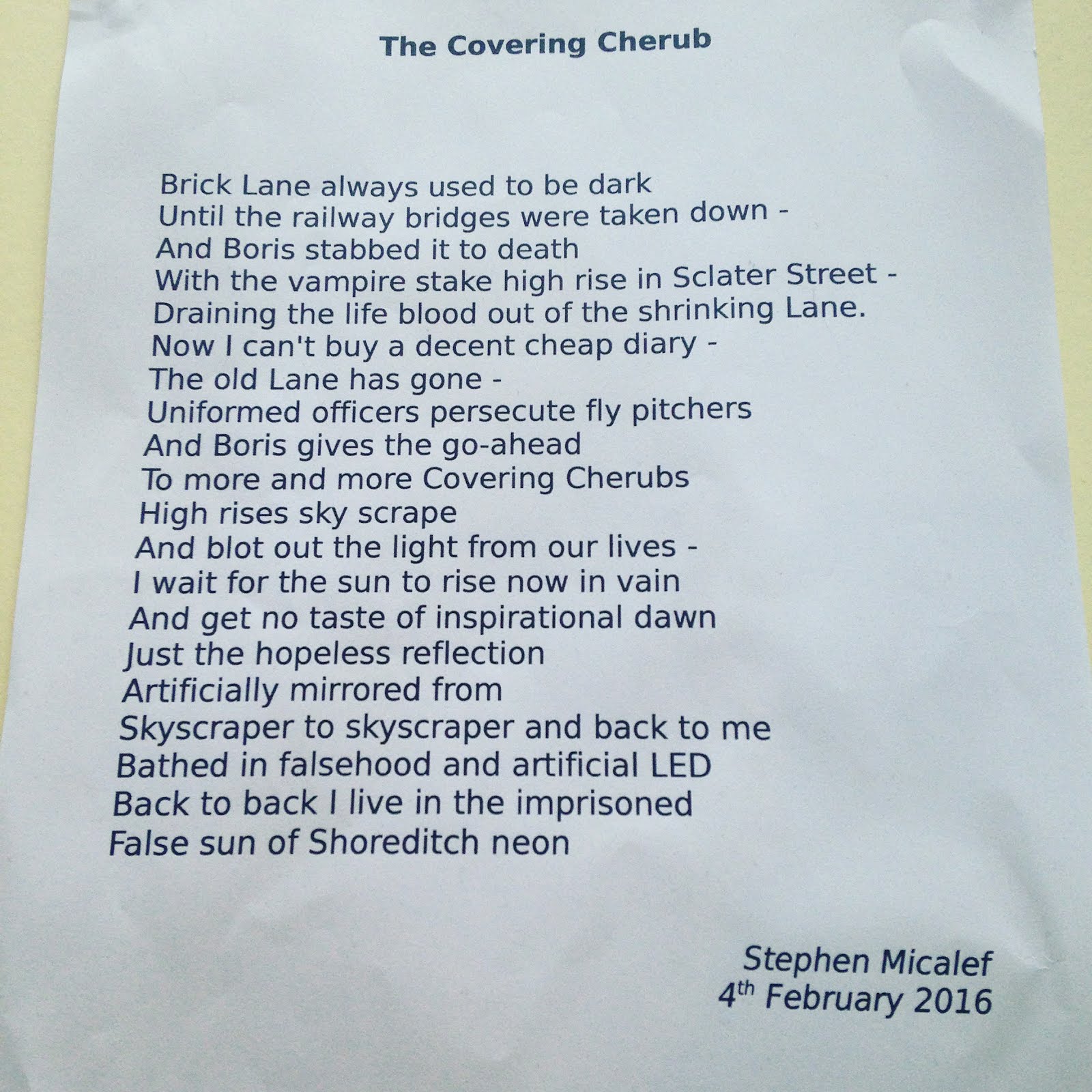
Poet Stephan Micalef wrote some poems for the exhibition which are included. Earlier in May, Robin also organised a protest poetry evening of poets reading their work about the developments, with a Blakean theme, called Dark Satanic Millionaires.


Practical advice and inspiration for the campaigner are also here: SAVE’s vision for the Strand buildings that were almost demolished last summer, drawn by architect John Burrell, and their flowchart (created by myself and Mike Fox especially for the exhibition, and designed by Olga Gusarova Tchalenko.)


Robin has made some stunning posters for the exhibition that I include here: their punk aesthetic and thoughtful content are activism of a powerful kind. They have a Blakean theme, calling the campaigners 'recording angels', and the artists 'interpreting angels.’ I remember one of my predecessors at SAVE citing ‘wanting to be on the side of the angels’ as being a major motivation for developers to stop fighting the local community and to work with them. Let’s hope that this exhibition creates a few angels. Go and have a look and take your local property developer. 

The exhibition is open until 5th June between 12 and 2pm every day, or by appointment.  To make an appointment outside these hours contact Robin Hatton Gore: rt_hattongore@yahoo.co.uk 


Monday, 16 May 2016

Moscow New Year 1993: Russian and other languages.


One day, Lex announced, into his moustache and with little enthusiasm, that Ira Vashchenko had bought tickets for the theatre. I still didn’t really know Ira and felt shy of her -  apart from in Liza’s home in Chiswick, I had only spoken to her a little, on New Year’s eve. Maybe because she knew Liza and I felt that I ought to have been able to speak Russian better than I did, or because I was agonisingly self conscious. I wore all grey clothes and army boots as I hadn’t known what to wear for a New Year’s trip to Moscow - that way I was camouflaged and vaguely sexless. Indeed, on getting off the metro at Arbatskaya a man took me under the arm one day and said ‘girls shouldn’t dress like this.’ It was an admonition. Ira, an artist, at that time painted the blind facades of buildings facing into courtyards with narrow strips of sky above them. She wore long skirts and pretty beads, and her hair was cut in a loose bob below her ears. She was smiling and joyful and even though she had strong opinions about things, she laughed easily.

The tickets were for Leshchi - The Wood Demon - by Gogol. I remember the papery tickets and the theatre foyer - the dim light emitted by the wall-mounted lighting, and the parquet floor, with its large pieces of wood, pale, varnished and well trodden. I don’t remember anything about the spektakl itself - I would have been happily sunk in my own thoughts, the alien words flying over my head. I remember coming out on to the street afterwards, all of us wrapped up in our winter clothes. Ira had on a long coat - she caught me by the arms, laughing, and span me around on the snowy street. I was startled and happy that she had done this, had shown me this much attention, but too shy to respond with anything but a smile, my body refusing to carry on the moment and swing itself around. I dropped my arms awkwardly. 

I was in the magical early period in my relationship with Russia when I felt I had nothing to offer, and was painfully aware of not being able to speak the language. I felt Ira had bigger fish to fry - other conversations to have. So her swinging me around in the snow was a great honour, that I didn’t know how to rise to. It was her way of talking to me. Most people have another language apart from actual words: Lex and I had the language of vodka - Yuri and I had his broken english - Sveta and Lex’s mother embraced me in their maternal kindness and the language of giving (lots of food) and Ira’s bother Senka and I spent an evening walking around Taganskaya in total silence eating ice-cream, him in a battered WW2 flying jacket. Needless to say, Ira and I now sit for hours chatting and drinking tea in the window of her Moscow apartment, the tree branches close up against the window. 

Monday, 9 May 2016

'My Stubborn Tongue'

This week Anna Fishbeyn came to Pushkin House with a performance that rocked the rafters of our 1703 abode: My Stubborn Tongue. Through acting and singing, with a piano accompaniment, Anna recounts the experience of moving to the U.S. as a 9 year-old child as part of the Jackson-Vanick agreement between the U.S. and Russia, when Russian Jews were, effectively, traded for grain. As she says: “America wanted the Russian Jews to demonstrate to the world how oppressive the Soviet Union was, and Russia needed grain, Russia was starving.” Against this bleak backdrop of human trading, Anna with great humour and insight recounts the ups and downs of being a Russian immigrant with an accent in the US at a time when people with accents were treated as second class citizens (as is still the case in some places). Anna watched her mother continue to be mistreated in department stores and restaurants simply because of her accent, and her family was repeatedly told to go back to Russia during their early years in the U.S.
 
The stunning Anna Fishbeyn in action
Anna decided to train her accent out of her tongue and to become as American as possible. She changed her name to Annie and spoke flawless English. But her roots were betrayed when her friends would come to her house to be fed Salat Olivye and encouraged to participate in the family’s regular after-dinner performances as her father played the balalaika and her mother sang opera. Her mother and grandmother had drummed into her head that kissing led to sex and sex could lead to only one thing - marriage. So when Anna started to date, she didn’t simply open up about her origins - she “forced her culture” on her dates: she would turn the subject to Anti-Semitism and Stalin before the bra could be removed, and perhaps sing some Russian laments. This was in order to check whether the boy in question was willing to take this stuff on.

As an immigrant, Anna needed to convey to the person she may be about to become intimate with, something of herself, what she had escaped, her background - that even if her family chose to leave that culture, part of it stayed with them. She does an impression of the guy’s response upon hearing about her Russian childhood, ‘Um I can understand that’ he says, desperately trying and desperately keen to get her bra off, ‘Actually I can’t understand that because I grew up in California, and it was pretty sunny, you know like the S.U.N,” pointing at the sky, “and Vitamin D gives you endorphins.” Touchingly, at Thanksgiving, the toasts are all to America; and the family attempts to feed Anna’s American friend the delicacy of cow’s brains as well as the turkey. 

I identified with this behaviour with boys - even though I never emigrated to Russia, I immersed myself in Russia over the years when most of my friends were rooting their lives and careers in the UK. It was hard for me to reconcile these parts of myself when visiting home from Russia, or even for the first years after my return when I was still traveling there a lot. On dates with ‘suitable’ English boys, I would rabbit on about Russia and use Russian words when nervous - I wanted to see if they would take it on, but also, for me, it was a safety mechanism to hide behind. And anyway, deep, dark intense subjects are a good precursor to sex, aren’t they?

Anna Fishbeyn performing in 'My Stubborn Tongue'
Having passed entirely convincingly as an American for many years, Anna decided to embrace her Russianness. She reverted to Anna (the Russian pronounced more like Honor) and began having to explain herself at parties. She was stunned by how little people knew about Russia. She said she originally wrote the play for her grandmother who came to the U.S., and never learned English. “My grandmother used to say, ‘We suffered in Russia and we suffered in America, what is the point of life?’” says Anna, “I wrote the play as an ode to my grandmother, an attempt to make sense of her suffering, of immigrant suffering.” But Anna also concedes that she wrote it for herself, to reconcile the disparate parts of personality. She does this literally also - this is a one-woman show and she plays several parts: her mother, grandmother, aunt, father, several non-plussed American boys, an Estee-Lauder saleslady, her ex-fiancé and his mother, and herself.

Her director is an American-Romanian, Adrian Roman, who saw his own story in Anna’s when he first saw the performance. In this sense, hers is a story anyone who has emigrated or lived abroad and embedded themselves deep into another culture, can identify with. Many people who come through the doors of Pushkin House - whether it is Russians now living in London, or other foreign nationals who have lived a long time in Russia - have a misplaced or split identity syndrome, confused cultural references and a desire to piece it all together. Anna Fishbeyn performs this reconciliation in her play: watching her perform was healing and exhilarating.


Tuesday, 3 May 2016

The shuttle and the egg: a Russian Easter blog.


The apartments on Golden Lane where I live have little storage and the aesthetic is minimalist. Even so there are many things that decorate my rooms that serve no purpose but I am unable to throw away. In this and coming blogs I write about some of my Russian objects.

This shuttle was given to me by my Yuri and Sveta Vashchenko who have looked after me so well in Russia, especially in the first years I travelled there. Their dacha in Kostromskaya Oblast is full of such things - inherited and found in the empty dachas in the village and neighbouring villages, some of which are entirely abandoned. 

From first visiting Russia I always found that there was little to collect - few beautiful things were available to buy - this is no longer the case but it was then - it was difficult to decorate my flat and make things pretty. But Sveta always could. She could make a dish of lobio from tinned kidney beans taste wonderful and fresh, just with the help of a sprig of coriander. She could make soup out of some herbs from the dacha garden and some tinned meat. She could make breakfast pancakes out of a cup of milk and some flour. And she could decorate with whatever was to hand: their dacha is decorated with these peasant objects - utensils, tools - and also embroidered linens. In the 1980s, my mother invented the phrase ‘shabby chic’ - Sveta was also a natural adept. Their apartment in Moscow was made decorative and sophisticated by the lightest of touches. In their case it was elegant, simple, pre-revolutionary art nouveau photo frames, often with tiny openings for the actual photo. Yuri and Sveta’s bed has, instead of a bedstead - a dozen or so of these on the walls, holding tiny photographs of their parents and themselves and their children, some of them processed by Yuri in the darkroom in Sveta’s former studio. 


Their bed was narrow - I only noticed because we arranged for an American photographer to stay there one summer when they were at the dacha and he mentioned it - that it was the size of a single american bed. In the countryside Yuri and Sveta often slept in the senoval - the hayloft - where tall grass from around the house, scythed (by Sveta) was dried and then placed. It was the most fragrant place to sleep in the world. It was also incredibly romantic and couples who slept there would skip down to breakfast in the morning with a spring in their step and sing song voices. Indeed I had my first sexual experiences in Russia on the senoval at the dacha. I smile to think of it now - I was 19 and the boy in question a little younger. And there was another boy who slept there too - we always thought he was asleep - but I heard him whispering about what he had seen to a friend of his later on in Moscow, and was mortified.

I marvelled at the aesthetics of Yuri and Sveta. They knew and recognised the natural, the authentic and knew to cherish it, in a blighted country where there was so little that was decorative. I wanted to recreate it, but I couldn’t, not in Russia - I didn’t know how to handle, nor find, the materials. Yuri and Sveta did - they had an eye for it. This present of the spindle was part of that. It is made of birch wood and is very light. It was made by hand, and has been smoothed and polished by use and extensive handling. It was a kind of blessing for my choosing to be in Russia.

The egg I bought in Izmailovo - the flea market where you could, beginning in the late 1990s, buy soviet objets. Handicrafts began to become more popular to at this time also and painted eggs were one of the things that were sold. 

This weekend was Russian Orthodox Easter. At home people colour eggs dark red with onion skins - or you can buy turned and painted wooden eggs like this - a symbol of rebirth and hope.

Monday, 25 April 2016

New Year 1992-3, Stary Arbat, Moscow

(a continuation from earlier blog posts)

Leaving Lex’s parents apartment, we walked a little way up the deserted Arbat, recently pedestrianised, and then ducked under an arch that ran under a building and led into a courtyard. It was snowy and the street lamps threw a dusty yellow glow on to the snow. I followed Lex to a corner in the asymmetrical courtyard and we were buzzed in. The juddering lift lurched to a halt at the fourth floor and at our ring the door opened on to a flat chattering with voices, full of smoke, and the twirl of dull-coloured skirts and a smell of sweat that didn’t smell English. The door opened straight on to a corridor that ran down the centre of the flat, with the rooms opening off it. The walls of the corridor were lined books, and it felt like a party flat - there was one big room and the other rooms were small - Nikolai Vsevoldovich’s study, the kitchen, and the youngest son, Tikhon’s bedroom. These were the Kotrelevs - a Moscow intelligentsia family. Nikolai Vsevoldovich was an esteemed translator of the Russian nationalist philosopher Vladimir Solovyev. His wife was a petite swarthy woman called Tatyana and nicknamed Chuda - miracle - her expression was provocative and wry - this was clearly a family that had been brought up on teasing. She taught art zaochno - by correspondence - the apartment was full of painted boards and canvases sent to her from all over the former USSR, of the interior of peasant huts, still lives, flowers, a cross between outsider art and Russian academia. There were four children, which seemed a normal amount to me, being from a family of four, but it was clearly not the norm, somehow this family was different, upholding something traditional in a society where the family unit had been put under serious strain. There were two girls and two boys.

By the time we had arrive at about half past midnight, on the first day of 1993, the zastol’e had broken up and people were moving hither and thither in the flat. Chuda ushered us into the kitchen, which was full of smokers, and offered us a pirog baked in a rectangular tray with thin flat pastry and a fine layer of cheese. To her amazement, I turned down the great delicacy of the jellied beef. Chuda was dashing around twittering like a bird and Lex was laughing into his moustache. She sat us down at the tiny kitchen table and with a great sigh pressed play on the clunky buttons of the answer machine. The tape whirred and a deep bass voice, with very correct pronunciation said ‘Mamochka my dear, Happy New Year. We have marked it here in Askhabad. I am still in prison but they are letting me out in a week. They have cut my sentence. It is not bad in the prison, we made a pirog. What else… Next week we will resume band practice and the band says it is missing me I think that is why they are letting me out. My tuba playing is coming on very well. Kiss everyone from me and I kiss you. Poka’ This was, Chuda’s eldest son, the apple of her eye, and Lex’s great friend. He had a fine voice. He was on army service and had been posted in Turkmenistan near Ashkhabad. He had been put in army gaol for carrying a pistol when he went into Ashkhabad in mufti. Chuda relished the story of her good little boy being so bad. Lex translated the story into Lex language which I had mastered by this time.

Moments later I was cornered by an enormous young man, Vanya Simyonov, who was all beard and booming voice. He asked me how to translate the Old Russian liturgy into old english. I looked at him in puzzlement, feeling like a terrible ambassador for England and a disappointing visitor. I couldn’t tell him anything at all about old english except say ‘Chaucer’ with a Russian accent. I felt stupid about that for twenty years until he and his family came to stay and I introduced him to a Russian priest in a village in norfolk with whom we had tea - an exculpation. 

By this time, Lex was making murmured goodbyes and bundling me into my coat. New Year’s night is short and there were many friends to see - onwards!

Two blocks up the Arbat we turned into Starokonyeshenny Pereulok and then right under an arch into another courtyard. Past two rubbish containers we arrived at a door. Lex pushed against the door - it opened into total darkness. We walked up seven flights, each flight curving steeply back on itself. At the top we came face to face with a cage. This was the first time I had come up against the Russian phenomenon of inhabiting spaces that were not intended for habitation - the fag ends of buildings - the storage areas. A shadowy figure appeared behind the cage and shoved his hand towards us filled with a bunch of jangling keys. In a sing song voice he talked Lex through unlocking the caged door. The door behind that, glowing with light, led straight into an enormous space - a studio masterskaya - the place where the master works. 

Yuri Vashchenko was the father of Lex’s great friend Ira - he was an artist who lived part of the year in America - and this was his masterskaya. With exaggerated chivalry, Yuri divested me of my coat and hat and hung them up. It was the attic: the space was divided into two - one half was a large room with a ceiling that sloped from the centre towards a window that looked over zinc roofs. Large canvases leant against the wall that divided the room from the other half of the attic, where, I later saw when I peeked in, was a large brass bed and a small skylight under which was placed a chair - oh toska! And then, tucked away in an awkward corner, was the most important spot of all - a makeshift kitchen made up of a miniature fridge, single hotplate and a couple of shelves, and the table - round and low - the walls hung with carpets and an oval mirror - a long low velvet upholstered day bed, and the steps up into the main room made extra seats. By all accounts this was the least prepossessing part of the room - no window and a low ceiling - but what need for windows when you have each other to look at, and a low hung light over the table! The window, letting in the prosaic thing known as light, had a practical purpose, to help Yuri create work.


Yuri’s wife Sveta was sitting by the single hot plate, and turned to us with a smile, rising and with her arms outstretched pressed Lex’s shoulders and kissed him on the forehead. She gave me three vehement kisses hello. She was playful and radiant. It felt like a mixture of the beginning of a great adventure, and of coming home. They had not yet eaten.